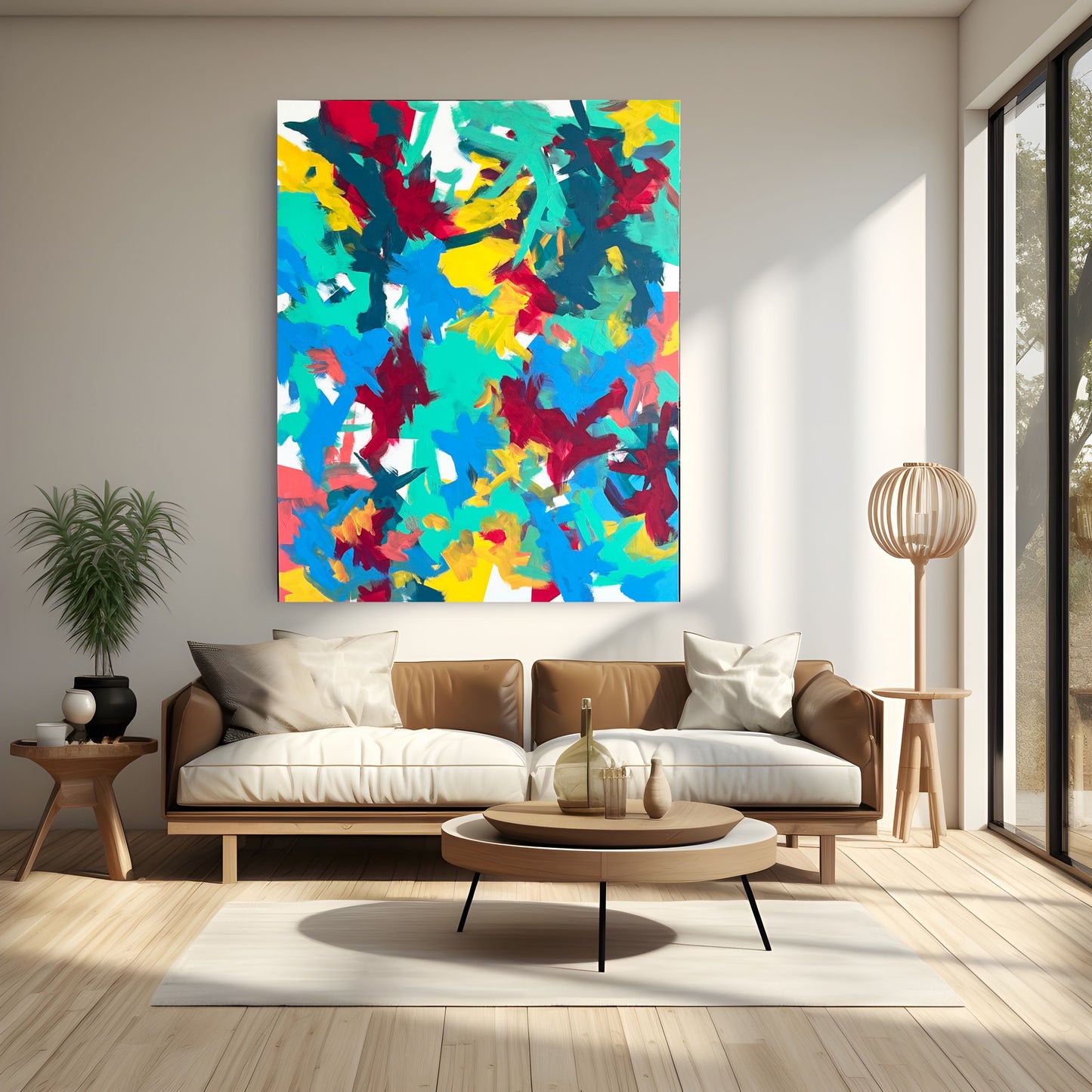
Wild Chorus 48" x 60"
Wild Chorus 48" x 60"

Its Strength—and Its Critical Risk
The painting’s immediate visual pleasure is one of its strengths. The palette is energetic and accessible, while the title gives viewers a productive way to enter the work. The painting can be appreciated sensorially before it is interpreted intellectually.
At the same time, brightly colored gestural abstraction carries a particular risk in contemporary painting: it can be perceived as decorative or generic when its gestures are not connected to a distinctive process, subject, or conceptual framework. Because the language of spontaneous abstraction has a substantial history, energetic brushwork alone does not automatically make a painting critically contemporary.
What distinguishes Wild Chorus is its potential idea of polyphony—many independent presences forming a temporary whole. That concept could be strengthened through a broader series exploring sound, conversation, ecology, crowds, emotional multiplicity, or collective identity. The work would then become not simply an attractive arrangement of expressive colors, but part of a sustained investigation into how difference can occupy one space.
Material decisions could deepen that position as well. Greater variation between translucent and opaque paint, deliberate scraping or removal, shifts in surface texture, or repeated forms across several paintings could make the process more identifiable. Contemporary relevance often emerges not from one isolated stylistic feature but from the relationship among image, material, title, process, and surrounding body of work.
Conclusion
Wild Chorus belongs within contemporary painting because it uses a historically recognizable language—gestural abstraction—to explore a distinctly current idea of multiplicity. Its composition rejects a fixed center, its colors maintain separate identities, and its marks create unity through collision rather than uniformity.
Its strongest contemporary proposition is contained in the word chorus. The painting replaces the fantasy of one commanding artistic voice with a field of overlapping voices. It is not harmonious because every element agrees; it is harmonious because disagreement, interruption, and difference are allowed to remain visible.
The work therefore stands at an intersection of Abstract Expressionist gesture, allover composition, contemporary abstraction, and suggestive figuration. Its challenge is to ensure that its exuberant surface is understood not merely as spontaneous decoration, but as an intentional investigation of collective energy. At its best, Wild Chorus presents painting as a social and sensory space: crowded, unstable, joyful, and held together without being forced into order.